Blog
The Ladder of Sinai
On The Ladder of Divine Ascent of St John Climacus
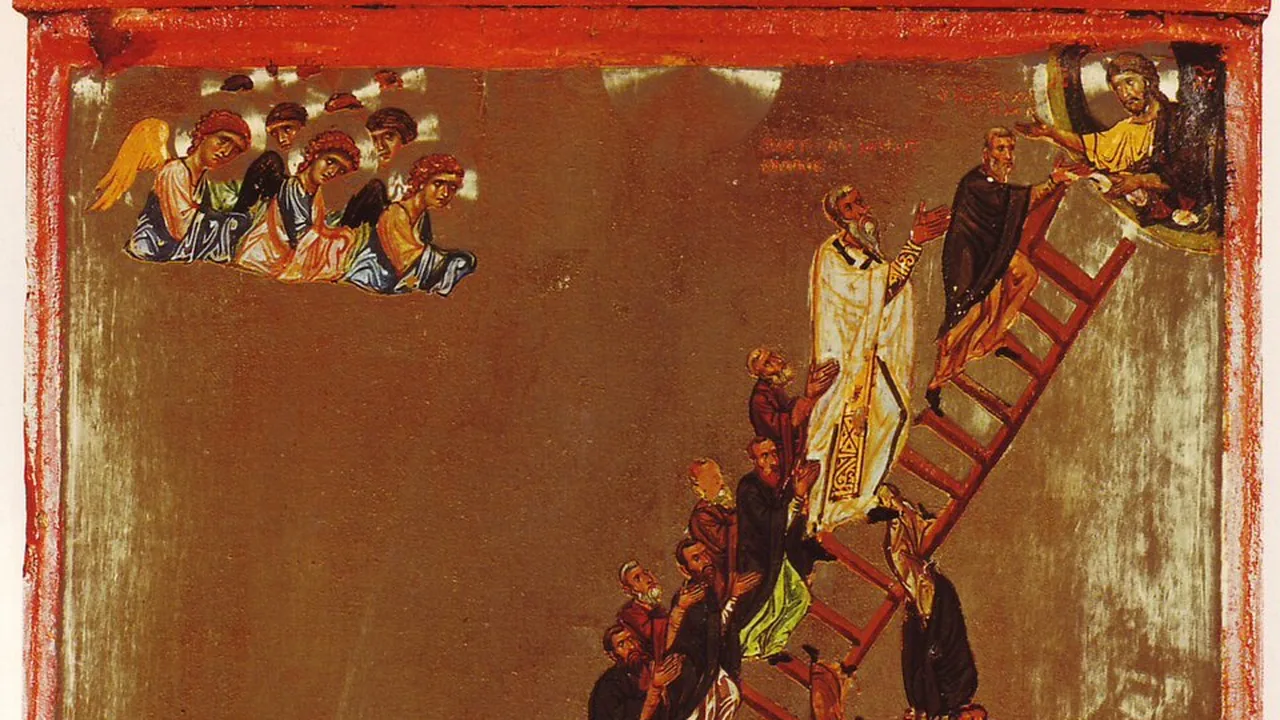
In the Monastery of St Catherine on Sinai there is an icon from the twelfth century that every monk knows, even one who has never seen it with his own eyes. A ladder stands slanting from the earth to heaven. Monks in dark habits are climbing it; the topmost has almost reached the last rung, and Christ is stretching out His hand to him. Small black figures with arrows and ropes flit along the ladder, and some of the climbers fall. In one corner angels look on, and at the foot a group of monks stands with raised hands, praying for those who are still climbing.
It is a sober icon. It does not promise that the climb is easy. But it also shows that no one climbs alone: at the foot of the ladder, people are praying.
A book for the brethren
The icon takes its subject from a book. In the seventh century St John, abbot of the monastery at the foot of the mountain where Moses received the tablets of the Law, wrote a book for monks. Another John, the abbot of Raithu by the Red Sea, had asked him to. The life that Daniel of Raithu wrote of him tells how he came to Sinai as a young man, learnt obedience under an old monk and lived for many years in solitude before the brethren chose him as their abbot. He wrote not from books alone, but above all from what he had seen happen in his brethren and in himself.
The author called his book a ladder, after the ladder that the patriarch Jacob saw in his dream, reaching from earth to heaven, with the angels of God ascending and descending on it. It has thirty steps, as many as the Lord’s years when He was baptised in the Jordan. Ever since, the Church has called its author John of the Ladder, John Climacus.
From the bottom upwards
The ladder begins at the bottom, where each of us stands. The first steps are renunciation, detachment, exile, obedience, repentance, the remembrance of death, and mourning. These are the steps of the beginning, and John does not hide that the beginning is hard. Repentance, he says, is the renewal of baptism. In that step he describes a monastery near Alexandria known as ‘the Prison’, where monks who had fallen wept for their sins day and night. He visited it and wrote down what he saw without softening it, and yet hope speaks from it: no one has fallen so low that he cannot rise. Mourning he calls a sorrow that brings joy.
Then come the passions, described as a physician describes illnesses he has watched run their course: anger and the remembrance of wrongs, slander and talkativeness, lying, despondency, gluttony, lust, love of money, vainglory and pride. John knows them from within. Talkativeness, he says, is the throne on which vainglory loves to sit. Anyone who reads such sentences feels caught out, and that is the intention: to see the passions described like this is to come to know oneself.
Only then does the way lead further up, to meekness, simplicity and humility, to discernment, stillness and prayer, to dispassion, and at last to what stands above all: faith, hope and love, ‘but the greatest of these is love’. Of prayer John writes that it needs few words: a single word from the publican won God’s mercy, and a single cry of faith saved the thief on the cross. Of stillness: ‘Let the remembrance of Jesus be united to your breath, and then you will know the value of stillness.’ And of love he says that by its nature it is a likeness to God, as far as that is possible for a human being.
For those in the world too
John wrote for monks, but the Church has never kept his book for the monasteries alone. During Great Lent it is widely read, in monasteries and in the homes of the faithful, and the Fourth Sunday of Great Lent is dedicated to him. He knew that others besides monks came to him with their questions. In the first step he tells of people in the world who asked how they too, married and weighed down with cares, could follow that life. His answer was roughly this: do all the good you can, speak evil of no one, rob no one, tell no lies, despise no one and carry no hatred, do not stay away from church, be merciful to those in need, and you will not be far from the Kingdom of Heaven.
It is the same ladder, set up in a different place: in a kitchen, in an office, at the bedside of a sick child.
How one reads it
Anyone who opens this book may expect a treatise on lofty spiritual states. What he finds is a father who knows how people fall and get up again. ‘Let him who thinks he stands take heed lest he fall,’ wrote the apostle, and John repeats it after him on many a page. The ladder is not a ranking. Whoever starts counting which step he has reached, or his neighbour has reached, has already fallen. One climbs it only with humility, and humility is usually learnt at the bottom.
That is why the Ladder is read slowly: one step a day, sometimes a single sentence a week. One reads it in order to live by it. Many take it up during Great Lent, because the Church commemorates St John in those weeks, and simply begin at the first step. Anyone who has a spiritual father would do well to read it with him; what John writes about obedience is also advice to the reader of his own book.
At the end, after all the warnings, John writes not a stern rule but an invitation: ‘Ascend, brothers, ascend eagerly.’ He adds the words of the prophet: ‘Come, let us go up to the mountain of the Lord.’ After almost fourteen centuries that invitation has not grown old.
About the book
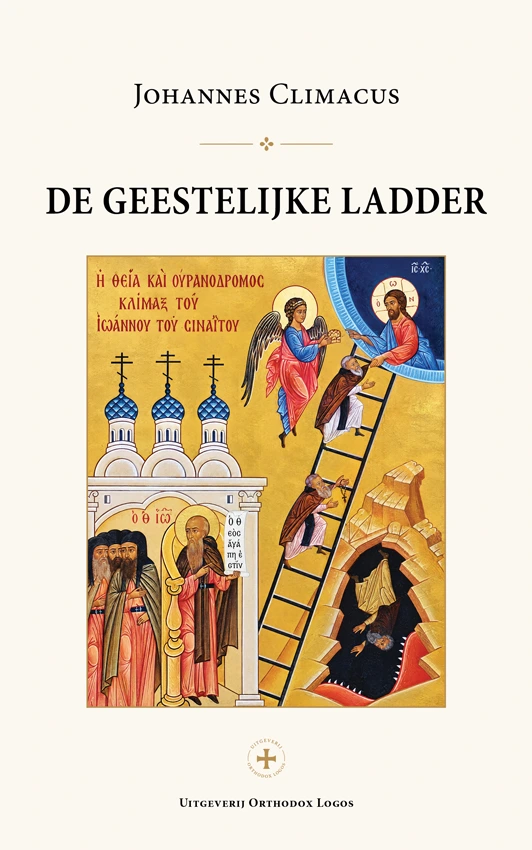
The Ladder of Divine Ascent has long been available to English readers in several translations. Our own edition is in Dutch: De Geestelijke Ladder, translated from the Greek by Paul Gilis, who continued the work of Father Christofoor Wagenaar. The translation was first published in 2002 by the Abbey of Bethlehem at Bonheiden and has now been newly typeset and republished with the abbey’s permission. Besides the thirty steps it contains the life of St John as Daniel of Raithu recorded it, the translator’s introduction, the letter To the Shepherd for those who guide others spiritually, and notes on every step with the Greek key words. It is available in hardback and paperback.