Blog
The Bible in the Orthodox Church: which translation, and how to read it
On Scripture in the life of the Church, and which translation to read
In every Orthodox church a book lies on the altar table. It is the Gospel, often bound in metal and adorned with icons. At the Little Entrance of the Divine Liturgy it is carried in a short procession and brought back in through the royal doors, and at Sunday Matins the faithful come forward to kiss it. Anyone who wants to know the place of the Bible in the Orthodox Church may begin there: Scripture is first of all a book that is read and sung in the Church.
Those who do not yet know the Orthodox Church will find a short introduction in our article What is Orthodox Christianity? Here the subject is the Bible: which text the Church reads, which translations there are, and how to begin reading yourself.
The book on the altar
Throughout the year Scripture is read in the services in a fixed order. From Pascha to Pentecost the Church reads the Gospel of John. After Pentecost comes Matthew, after the Elevation of the Cross in September Luke, and in Great Lent, on Saturdays and Sundays, Mark. Anyone who follows the daily readings for a year hears the four Gospels, the Acts and the letters of the apostles.
The Old Testament is heard above all at Vespers, in readings called paremias, and in the psalms. In monasteries the whole Psalter is read every week, twice a week in Great Lent. Many Orthodox prayers are themselves built from verses of the psalms. Whoever follows the services comes to know the psalms without ever sitting down to study them.
Which Old Testament?
The Orthodox Church reads the Old Testament in the Septuagint, the Greek translation made in Alexandria in the centuries before Christ. It is the text the apostles usually quote, and the text from which the Fathers preached. Western translations generally follow the Hebrew text. The differences are usually small, but sometimes noticeable.
The Septuagint also contains books that are not in the Hebrew Bible: among them Tobit, Judith, the books of the Maccabees, the Wisdom of Solomon, Sirach, Baruch and the Letter of Jeremiah, as well as longer versions of Esther and Daniel. In the Greek tradition they are called anagignoskomena, books that are read. No ecumenical council ever fixed the list once and for all, and not every Orthodox Church prints exactly the same books.
The psalms are numbered differently too. Psalm 50 of the Septuagint, ‘Have mercy on me, O God, according to Thy great mercy’, is Psalm 51 in most English Bibles. The psalm of creation with which every Vespers begins is Psalm 103 in the Septuagint and Psalm 104 elsewhere. Anyone who lays an Orthodox prayer book beside an ordinary Bible will often have to look one number higher.
And the New Testament?
The New Testament is the same for almost all Christians: twenty-seven books, written in Greek. The Greek Church reads it in the text the Patriarchate of Constantinople issued in 1904, based above all on the manuscripts used in the services for centuries. For those who read in translation, the differences from other editions of the Greek text matter little.
What to read in English
The Orthodox Study Bible (Thomas Nelson, 2008) gives an Old Testament translated from the Septuagint by the St Athanasius Academy, together with the New Testament of the New King James Version, with notes drawn from the Fathers. The New English Translation of the Septuagint (Oxford University Press, 2007) is a careful scholarly translation, not intended for use in the services. The older translation by Sir Lancelot Brenton is still widely read; it first appeared in 1844, and from 1851 with the books not found in the Hebrew Bible. For the New Testament, any sound modern translation will serve for daily reading. Your priest can tell you which translation is read in your parish.
Since 2024 readers in the Netherlands and Flanders have De Psalmen van de Vroege Kerk, a Dutch translation of the psalms from the Septuagint, published by the Nederlands-Vlaams Bijbelgenootschap. Two Orthodox priests were among the translators, and the translation is suitable for use in worship.
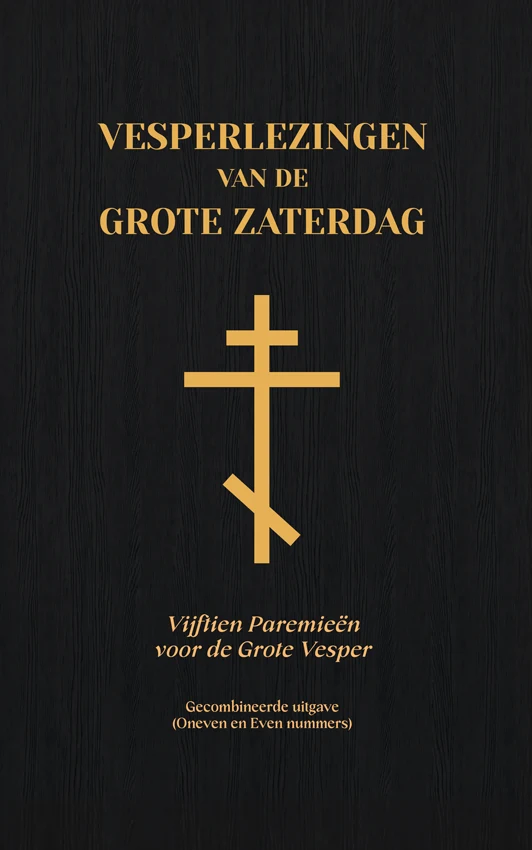
It has been given to us to publish one small part of the Septuagint in Dutch: the fifteen Old Testament readings heard at Vespers on Holy Saturday, from the creation to the song of the three young men in the furnace.
How to begin
The simplest way is to read along with the Church. Every day has its own reading from the Gospel and from the epistles; an Orthodox calendar or your parish website will give them. Whoever reads in this way reads at home what the Church reads that day.
One can read a little at a time, slowly, and begin with a short prayer. Scripture is not a textbook to be finished, but a word that is heard again and again. St John Chrysostom told his hearers: ‘This is the cause of all evils, the not knowing the Scriptures.’ He urged ordinary people with families and trades to read at home. The Fathers are the oldest readers of the Gospel, and whoever reads with them does not read alone.
Those who look for help will find it in commentary that follows the Fathers. In that spirit Jozef Wijker wrote, in Dutch, a commentary on the Gospel of Matthew and one on the Gospel of John: passage by passage, with the Fathers as guides and with what is known of time, place and language.
About the books
The Inner Cohesion between the Bible and the Fathers in Byzantine Tradition, in English, describes how Scripture and the Fathers were handed down together in Byzantine manuscripts. In Dutch we publish Vesperlezingen van de Grote Zaterdag, the fifteen paremias of Holy Saturday Vespers translated from the Septuagint, bound and in a convenient size. Our shop also carries Jozef Wijker’s commentaries Uitleg van het heilig Evangelie volgens Mattheüs and Uitleg van het heilig Evangelie volgens Johannes.
May the Lord open our minds to understand the Scriptures.
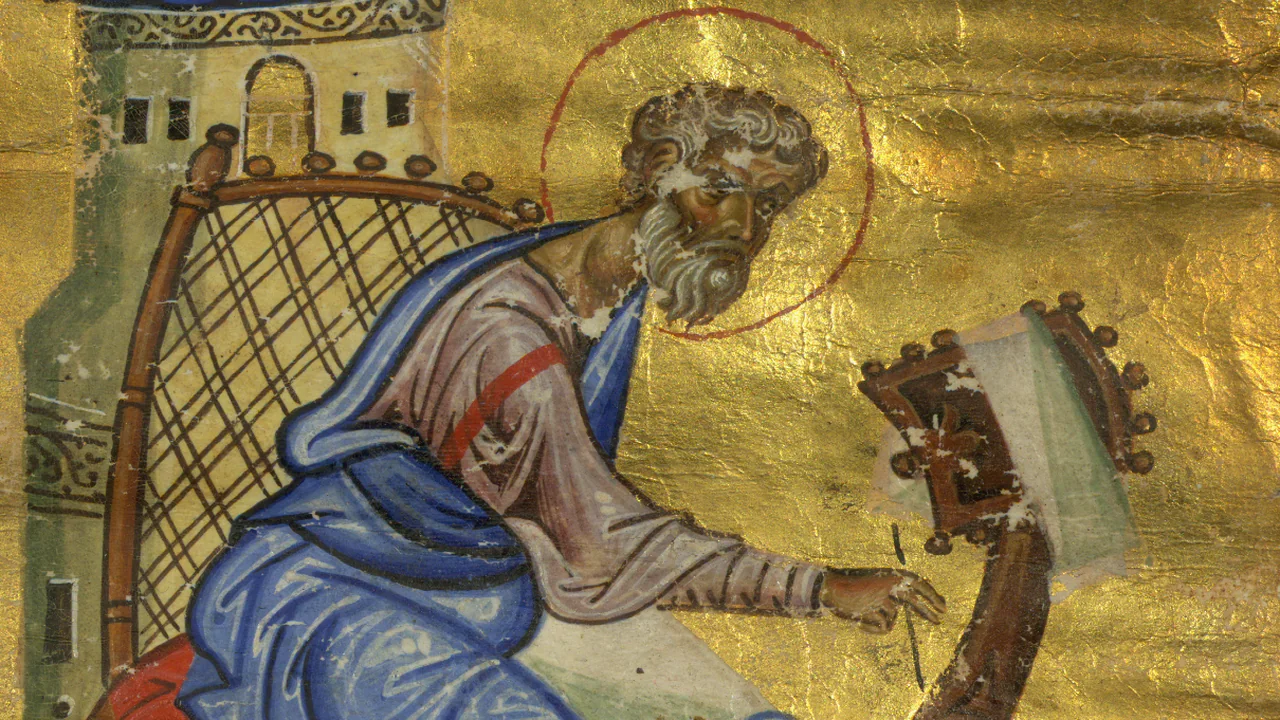
The image above this article shows the Evangelist Matthew writing his Gospel. In old Gospel books such portraits stood before each of the four Gospels. This leaf was painted in the twelfth century, probably in Constantinople, for a Gospel book of the monastery of the Great Lavra on Mount Athos; the leaf itself is now in the Walters Art Museum in Baltimore.